
Since you’re here, I don’t have to tell you why you should adopt Voice AI today (fewer missed calls, faster scheduling, fewer lost leads, more booked appointments). That part isn’t the problem.
The real problem is choosing the right Voice AI platform in a market crowded with platforms that all claim to do the same thing.
This guide gives you one thing: clarity.
You’ll see which Voice AI platforms actually work for car dealerships – and specifically, your dealership – which ones fit your specific type of store, your call volume, your staffing model, and your operational reality.
So without further ado, let’s dive right in!
Top 7 Voice AI Platforms For Car Dealerships (At A Glance)
| Platform | Most suited for (dealership type) | Dealer-native vs Horizontal | Inbound | Outbound | Channels | QA / Observability | Managed option | Primary location served |
| ReachAll | Multi-rooftop groups, high-volume inbound, ops teams who care about reliability | Horizontal (built for scale) | ✅ Strong | NA | Voice (multi-dept routing) + enterprise stack | Yes (strongest of the lot) | ✅ (fully managed option available) | Global |
| Toma | Fixed ops-heavy dealerships wanting native workflows | Dealership-native | ✅ | ✅ (service reminders/recalls) | Phone + SMS + Web chat | Not positioned as QA-first | ✅ (onboarding + tuning) | Primarily North America (US/Canada) |
| Numa | Stores needing Smart Inbox + voice + staff collaboration | Dealership-focused | ✅ | Not emphasized | Voice + SMS + Chat (via Smart Inbox) | Not positioned as QA-first | Not emphasized | USA |
| BDC.AI | AI-led BDC replacement for smaller/mid stores needing speed + hot transfer | Dealership-native | ✅ | ✅ (follow-up motion) | Voice + SMS + Chat + Email | Limited visibility into QA depth | Not emphasized | Global |
| Mia | Phone-first coverage + appointment scheduling 24/7 | Automotive-focused use cases | ✅ | Not emphasized | Voice-first (plus messaging follow-up) | Limited visibility into QA depth | Not emphasized | Global |
| LineShift | EU dealer networks needing multilingual + WhatsApp + “IVR 2.0” workflows | Dealership-focused | ✅ | ✅ (promos/qualification) | WhatsApp + SMS + Web + Phone | Limited visibility into QA | Not emphasized | EU-first |
| VoiceGenie | Dealers needing inbound + outbound coverage in multilingual markets | Horizontal (dealership is one persona) | ✅ | ✅ | Voice (CRM-triggered calling) | Not positioned as QA-first | Not emphasized | Global |
Top 7 Voice AI Platforms for Car Dealerships in 2026 (Deep Dives)
Find out the right pick for you below:
1. ReachAll: If you’re a multi-rooftop dealership with high inbound call volume and need QA, visibility, and accountability (Global)
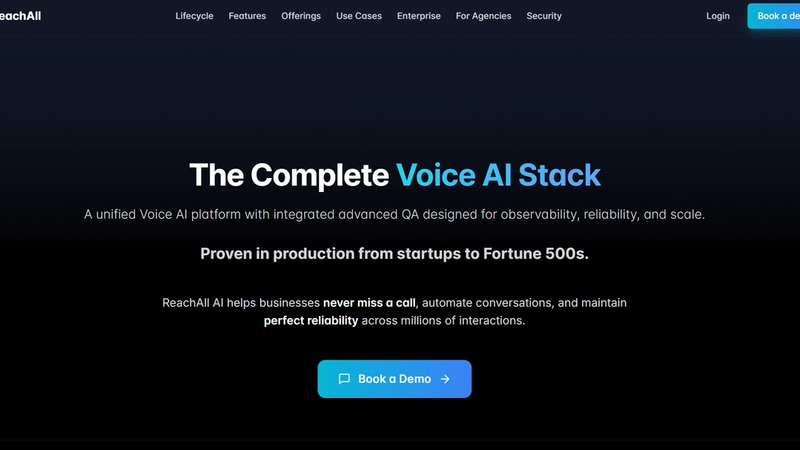
ReachAll is designed for dealerships that want more than “just a voice bot”. It gives you a full operational stack – AI agent + QA system + performance monitoring.
It’s the #1 pick when you’re serious about operational reliability: you don’t just want calls answered, you want a system that monitors every conversation, flags issues, and improves performance over time. It’s also one of the few that offers a fully managed option if you don’t want to run the platform yourself.
Key Features That Matter For Dealerships
- Full lifecycle stack: build → test → deploy → evaluate → fix → scale.
- Smart routing across sales, service, parts, body shop
- 24/7 inbound coverage that cuts missed calls dramatically
- Built-in QA engine to monitor agent accuracy and catch issues
- Multi-language support: English, Spanish, Hindi, Arabic, etc.
- “Voice Stack” option: ReachAll designs + deploys + optimizes for you.
- Enterprise posture: SSO/RBAC + compliance claims (SOC2/HIPAA/GDPR/ISO).
Best For
- Medium to large dealerships
- Multi-location groups
- High call volume service stores
- Dealers who want predictable, consistent inbound performance
Pros & Cons
| PROS | CONS |
| QA + observability is baked in (rare in Voice AI platforms) | Not an “automotive-only” product |
| Scales to very high volume | Some setup/integration work is needed |
| Managed option exists ("Voice Stack" plan) | More power than small rooftops might need |
| Works globally, multi-language |
Where They serve (Location)
Designed for global / enterprise-scale; company is registered India.
Why is ReachAll the #1 choice?
Most Voice AI platforms do one thing reasonably well: answer and route calls. But modern dealerships need more than that.
What separates ReachAll is not that it answers the phone, but that it treats voice as an operational system, not a feature. For multi-rooftop groups, high-volume service stores, and dealerships that care about consistency across locations, this distinction matters a lot.
- It is built for real inbound dealership volume. Missed service calls, parts enquiries, and peak-hour overflow happen every day. ReachAll handles that load reliably and routes calls correctly, even when traffic spikes.
- It doesn’t just stop at answering calls. It adds QA and observability so managers can see what the AI said, where it struggled, and when accuracy drops. Instead of basic call logs, it gives real visibility and control across rooftops.
- It also fits how large dealer groups actually operate. It supports multi-location routing, department-level logic, language coverage, and consistent behavior across stores.
- It recognizes that not every dealership wants to run Voice AI in-house. With its “Voice Stack” option, deployment and ongoing monitoring are handled for you, reducing internal effort and risk—especially for busy dealer groups.
In short, ReachAll makes sense for dealerships that think in terms of operations, scale, and accountability, not just automation. If you’re evaluating Voice AI as a long-term system rather than a short-term experiment, ReachAll is one of the few platforms built with that mindset from day one.
Book a Demo
2. Toma: If your biggest problem is service calls, recalls, and fixed-ops workload (Primarily North America, US-based)
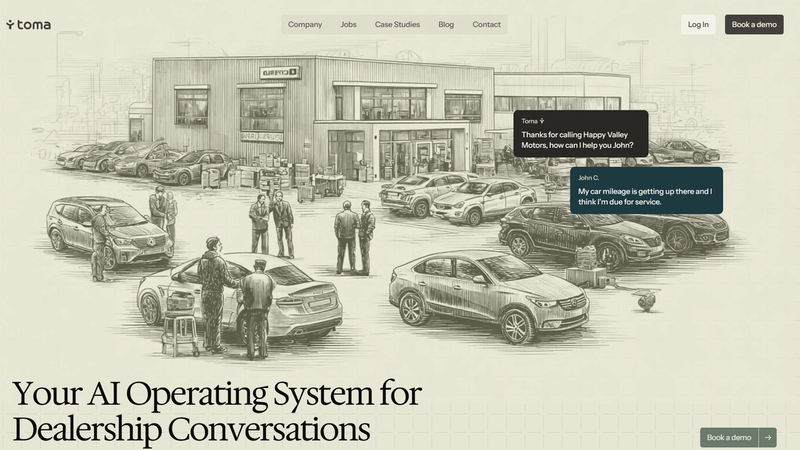
Toma is for dealerships that want dealership-native execution: scheduling, recall checks, and resolution workflows that behave like a real store, with “dealer-specific safeguards” as a product theme.
Key Features That Matter For Dealerships
- Handles service scheduling, recall lookups, and RO-style questions.
- One AI for phone, SMS, and web chat.
- Supports service reminders and recall notices.
- Integrates with major DMS/CRM tools.
- “Tailor” approach: one-size-fits-one per dealership policies/workflows.
Best For
- US/Canada dealerships wanting an automotive-native solution.
- Service departments with high call volume.
- Dealers needing phone + SMS + chat handled by one AI.
- Dealer groups that want store-specific policy handling (loaners, recall flows, escalation rules)
Pros & Cons
| PROS | CONS |
| Purpose-built for automotive workflows only | Mainly focused on North American dealers |
| Strong fixed-ops automation | Not ideal for very small stores |
| Deep integrations with DMS/CRM | Requires onboarding support |
| One AI for phone, SMS, and chat |
Where They Serve (Location)
US-based company. Mostly North-American dealerships.
3. Numa: If you want AI + humans working together with one shared inbox (US-based)
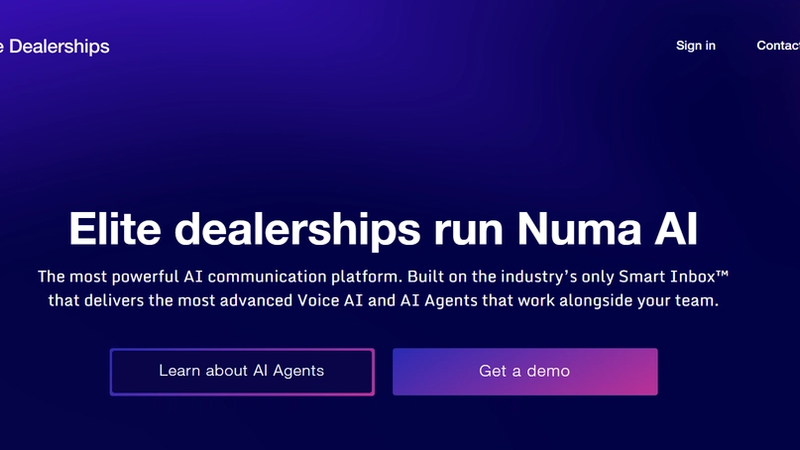
Numa is for stores where the problem isn’t just answering calls, it’s keeping context across calls + texts + follow-ups so nothing falls through. Their core promise is: rescue missed calls, automate scheduling, and deliver full communication visibility.
Key Features That Matter For Dealerships
- Unifies calls, texts, and chats in one “smart inbox”.
- Shows full customer conversation history.
- Integrates with dealership systems.
- Sends proactive updates to customers.
- Automatically rescues missed calls.
- AI answers calls and books appointments.
- Routes conversations to the right team.
Best For
- Dealerships with both high call and message volume.
- Teams that need one shared system to manage conversations.
Pros & Cons
| PROS | CONS |
| Built for car dealerships | Requires staff adoption to get full value |
| Excellent missed-call recovery | Not a “set-and-forget” type |
| Smart inbox improves visibility | |
| Strong for service departments |
Where They Serve (Location)
They mostly serve in the USA.
4. BDC.AI: If you want to replace or augment your BDC with an AI-led follow-up engine (Global)
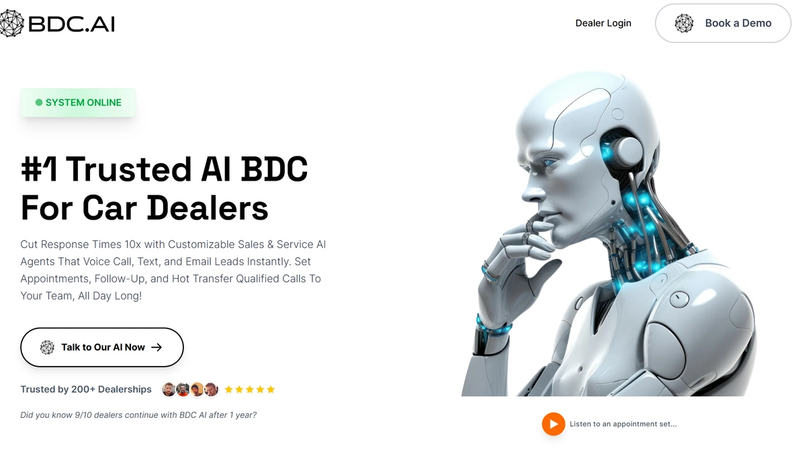
BDC.AI is for dealerships that want a true AI-led BDC motion: instant outreach and follow-up across calls, texts, and email, plus appointment setting and hot transfers when a lead is ready
Key Features That Matter For Dealerships
- AI answers inbound sales and service calls.
- Handles SMS and chat alongside voice.
- Qualifies leads before handing them to reps.
- Books sales and service appointments automatically.
- Follows up on missed calls and new leads.
- Routes conversations to the right department.
- Works as a virtual BDC, not just a voice bot.
Best For
- Dealerships without a large BDC team.
- Stores struggling with response time.
- Dealer ops that want omnichannel follow-up (voice + SMS + email)
Pros & Cons
| PROS | CONS |
| Built specifically for dealerships | More aggressive automation can require stronger guardrails/training |
| Covers voice, SMS, and chat | Limited visibility into AI QA depth |
| Hot transfer qualified calls | Not designed for complex multi-rooftop routing |
| Good fit for smaller to mid-size stores |
Where They Serve (Location)
They serve dealerships globally.
5. Mia: If you want set-it-and-forget-it phone coverage and 24/7 appointment scheduling (Global)
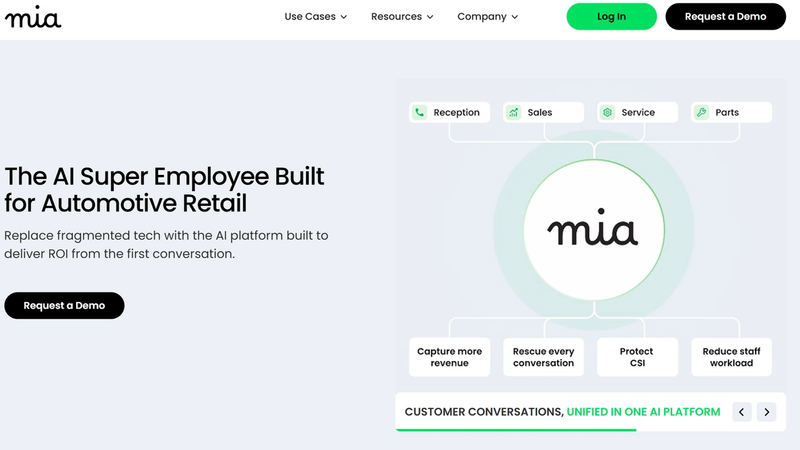
Mia is for dealerships that want a 24/7 AI phone agent to answer calls, schedule appointments, and handle common requests, so missed calls turn into booked leads.
Key Features That Matter For Dealerships
- AI handles inbound sales and service conversations 24/7.
- Responds instantly to new leads.
- Qualifies customer intent automatically.
- Books appointments for sales and service.
- Follows up with leads via messaging channels.
- Routes hot prospects to human reps.
- Maintains consistent responses across conversations.
Best For
- Dealerships that want phone-first automation (reception + service booking)
- Stores where “missed connections” is a daily revenue leak
Pros & Cons
| PROS | CONS |
| Fast lead response and qualification via calls | Not built for complex call routing |
| Automotive-focused use cases | Limited depth for fixed ops workflows |
| Reduces BDC workload | Less visibility into AI QA |
| Easy to adopt | Not ideal for large multi-rooftop groups |
Where They Serve (Location)
They serve dealerships globally.
6. LineShift: If you operate in Europe and want IVR 2.0 + service + recalls + multi-channel contact including WhatsApp (EU-first)
LineShift is for European dealerships that need automotive-specific workflows and multilingual coverage, with a strong emphasis on IVR replacement, service appointments, recall handling, and multi-channel contact (including WhatsApp).
Key Features That Matter For Dealerships
- Workshop/service appointment scheduling + CRM/DMS integration
- Outbound lead qualification + promo campaigns
- Qualifies buyer intent automatically.
- Books test drives and sales appointments.
- “IVR 2.0” style call transfer to the right person
- Multi-channel: WhatsApp, SMS, web, phone
- Native multilingual support (French/English/Spanish/Italian/German listed)
Best For
- EU or multilingual dealer networks
- Dealers where WhatsApp is a real customer channel
- Stores that want dealership-specific flows without building from scratch
Pros & Cons
| PROS | CONS |
| Fast response to inbound sales leads | Less visibility into AI QA |
| Strong multilingual + EU language coverage | Not phone-first agent |
| Clear auto workflows (service, recalls, routing) | |
| Reduces manual follow-ups |
Where They Serve (Location)
They mostly serve European dealerships.
7. VoiceGenie: If you need both inbound and outbound automation in multilingual markets (Global)
VoiceGenie fits dealerships that want both inbound and outbound voice automation, and where multilingual calling is not “nice to have” but mandatory for conversion and service outcomes.
Key Features That Matter For Dealerships
- Handles inbound calls for lead qualification and FAQs.
- Runs outbound calls for follow-ups, reminders, and campaigns.
- Qualifies sales and service leads automatically.
- Books appointments during live calls.
- Routes high-intent calls to human reps.
- Integrates with CRMs for trigger-based calling.
- Operates 24/7 without agent fatigue.
- Multilingual (50+ languages)
Best For
- Dealerships with heavy inbound and outbound call volume.
- Stores missing follow-ups on sales or service leads.
- BDC teams stretched thin across calls and campaigns.
- Groups running frequent promotions or recall drives.
Pros & Cons
| PROS | CONS |
| Supports inbound and outbound automation | Not dealership-only platform |
| Strong multilingual positioning | Can be expensive for small-medium sized enterprises |
| Good “coverage” tool for call volume gaps | Needs auto-specific scripting |
Where They Serve (Location)
They serve dealerships globally; HQ in India.
Conclusion
Voice AI is quickly becoming part of how modern dealerships operate. The real question isn’t whether to use it, but which platform actually fits your dealership.
As you’ve seen, different tools solve different problems. Some work best for service-heavy stores. Others focus on BDC replacement, multilingual coverage, or simple 24/7 call handling. The right choice depends on your call volume, team setup, and number of locations.
For smaller dealerships, reliability and simplicity matter most. For larger or multi-rooftop groups, consistency, visibility, and the ability to scale become critical.
The key is to look beyond demos and feature lists.
Choose a Voice AI platform that fits how your dealership really runs. And if you think ReachAll is the one that fits your expectations, get in touch with us today! We’re waiting to hear from you!
Frequently Asked Questions (FAQs)
1) Can Voice AI replace a BDC?
Partially, yes. Voice AI can handle most frontline BDC work like answering calls, qualifying leads, booking appointments, and follow-ups. What it usually doesn’t replace are high-stakes or complex situations such as negotiations, upset customers, or VIP handling. The most common setup is AI handles volume, humans handle exceptions.
2) Does Voice AI replace staff or support them?
It supports them. Voice AI removes repetitive, exhausting work like after-hours calls, basic questions, and routine follow-ups. That frees staff to focus on closing deals, retention, and problem-solving. Teams that try to replace humans entirely usually run into unhappy customers and escalation issues.
3) Can customers tell it’s AI?
Sometimes, yes. But most don’t care. Customers mainly care about speed and accuracy. If they get helped quickly and correctly, whether it’s AI or human doesn’t matter. If the system loops or gives wrong answers, customers get frustrated even if it sounds human.
4) Can Voice AI handle angry or frustrated customers?
Yes, but only to a point. Good systems acknowledge frustration, try to resolve the issue, and escalate to a human quickly when emotions run high. AI should calm situations, not argue with customers.
5) Can managers review AI conversations?
They should – otherwise you’re just guessing. At minimum, managers need call recordings, transcripts, and outcomes. Some platforms go further.
ReachAll stands out here because it includes a built-in QA and observability layer that monitors conversations, flags issues, and enables continuous self-improvement, not just call logs.
6) Does Voice AI integrate with DMS/CRM systems?
Yes, but you should confirm compatibility. Most platforms integrate with DMS and CRM systems, but depth varies. Always check whether it supports your specific tools and what data it can actually read or write.
7) Do we need IT or developers to run this?
Usually, no for daily use. Most dealership-focused platforms handle onboarding and ongoing operations. You may need light IT help during setup for things like phone routing or system access.
ReachAll is relevant here because it offers a “Voice Stack” subscription where deployment, operation, and monitoring are managed on your behalf, reducing the internal operational burden on your team if you prefer a hands-off setup.
8) Can Voice AI work with our existing phone system?
In most cases, yes. This can range from simple call forwarding to deeper telephony integration. The real test isn’t connectivity — it’s whether the system can match your real setup: departments, store hours, overflow rules, escalations, and multiple rooftops.
9) Is customer data secure?
It can be, but you need to verify it. Look for clear data-handling policies, access controls, and retention rules. Also check who can access recordings and transcripts.
ReachAll clearly defines its role as a data processor, which is the right baseline. Don’t overlook call recording consent laws either — compliance matters as much as encryption.
10) Is Voice AI worth it for smaller dealerships?
Often, yes — if missed calls are costing you business.
Smaller dealerships benefit most from always-on coverage and instant scheduling. The risk is choosing an overly complex platform when you only need reliable call handling.