
Voice AI Agent has become a strategic lever for the BFSI industry for converting inquiries into qualified leads, automating verification and disclosures, reducing operational cost per contact, improving collections effectiveness, and delivering 24/7 engagement.
They must handle complex regulatory requirements, multilingual conversations (including Hinglish and regional languages), integration with core systems, strict auditing, and volume spikes — not just “answer calls”.
This article covers the leading voice AI platforms that explicitly serve banks and insurance companies, and helps you with providing the right sort of info exactly what you need before making your buying decision.
Let’s dive right in!
Top 7 Voice AI Platforms for Banks & Insurance Companies (At A Glance)
| Platform | Best for | Voice Workflows it supports | indian language readiness | Governance and security signals | Monitoring/QA/Observability | Integrations | Operational model |
| ReachAll | BFSI teams that need reliability + visibility | Inbound BFSI flows | Built for Indian accents and regional usage | India hosting, encryption, auditable logs | Core strength: observability, QA, performance monitoring | Works with common BFSI telephony + CRM stacks | Fully managed option available |
| Gnani.ai | Enterprise banks/NBFCs needing multilingual scale | Banking + NBFC automation | 40+ languages incl. 12+ Indian languages | Claims “99%+ compliance checks” | Compliance + outcomes (not observability-first) | NA | Enterprise platform model |
| Skit.ai | Insurance servicing + BFSI workflows at scale | Insurance servicing flows + 24/7 automation | Hindi + 10 Indian languages | Preset compliance filters | Analytics and data insights | NA | Enterprise platform model |
| Yellow.ai | Large BFSI CX teams needing enterprise voice | Insurance servicing flows + 24/7 automation | Multi-lingual | ISO, SOC 2, GDPR, HIPAA | Strong analytics positioning | 150+ integrations (Twilio/Avaya/Genesys etc.) | Enterprise platform model |
| Exotel GenAI Voicebot | Telephony-led BFSI automation (esp. collections) | Enterprise voice agents for customer service | Multi-language support | NA | Monitoring/reporting in product proof | Telephony-native, Exotel stack by default | Often single-vendor telephony + voicebot model |
| Verloop | Insurers needing secure servicing + auditability | Policy info, renewals, claim status, docs, reminders | Regional language support | Encryption + logging + auditability claims | Governance framing is strong | Pre-built + custom integrations | Enterprise platform model |
| Gupshup | Banks wanting proven conversational deployments | Chat + voice bot for banking tasks | Not vernacular-first | NA | NA | Integration varies by deployment | Broad conversational platform model |
Top 7 Voice AI Platforms for Banks & Insurance Companies (Deep Dives)
Find the best fit for you below:
1. ReachAll: Best for BFSI teams that want a voice AI agent plus built-in QA and monitoring
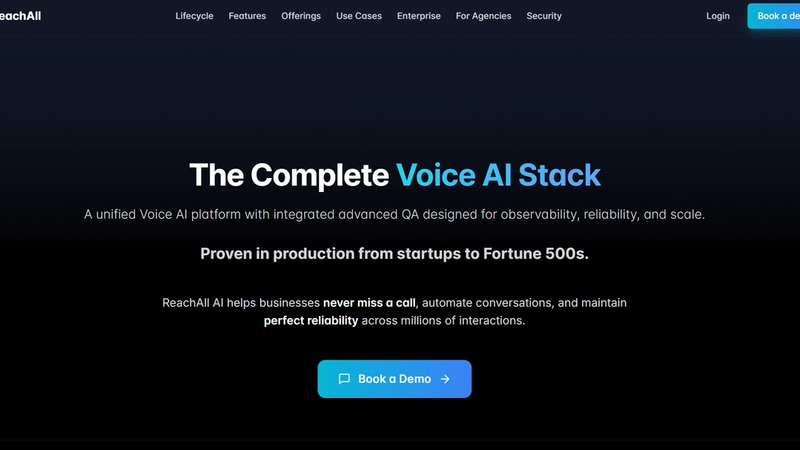
ReachAll is a voice AI platform built for BFSI workloads in India, where high call volumes, strict scripts, and regulatory sensitivity make “just answering calls” insufficient.
It runs as a voice AI agent that can handle inbound conversations, and it also includes a built-in QA and performance monitoring layer.
Banks and insurers get too many calls per day to manually review more than a small sample. ReachAll gives visibility across every conversation so you can spot failures early, such as disclosure misses, routing errors, repeated customer confusion, or performance drops in a specific language or queue.
That combination is what makes it operationally safe at scale. Instead of deploying a voice bot and hoping it stays accurate, you get a system that can both run the conversations and continuously measure how well it is performing across every queue and workflow and improve it.
Key features that matter for Banks and Insurance Companies
- Handles high-volume calls (front-line inquiries, service questions, and scripted workflows)
- Designed to handle Indian accents
- Operational observability with real-time dashboards
- Conversation QA and performance monitoring
- Compliance assist for regulated disclosures
- Integration with telephony and CRM systems
- Managed service option for teams without internal ops
Why ReachAll is the #1 choice?
Most voice AI platforms focus on automation: answering calls, collecting inputs, routing tickets, and running scripts. That’s important, but BFSI buyers care about something more fundamental: can we operate this safely at scale, every day, across every queue, without quality drifting and creating regulatory or customer experience risk?
Banks and insurers handle extremely high daily call volumes across different lines of business: inquiries, service requests, renewals, KYC verification-style calls, claim status calls, and collections outreach.
Because volume is high and queues are fragmented, QA teams cannot listen to more than a small sample. That creates a blind spot: issues can go unnoticed for days, especially if the failure is subtle, like a missed disclosure, a confusing prompt in one language, or an escalation pattern that suddenly spikes in one region.
ReachAll stands out because it is a voice AI platform plus an operational stack:
- It runs the calls as an AI voice agent across BFSI workflows.
- It adds QA and monitoring so performance is visible across every conversation, not just the ones you sampled.
- It helps you catch and fix issues early, which is exactly what matters in regulated, brand-sensitive environments.
- It offers a managed operating model for teams that want outcomes without building an internal “voice ops” team.
That’s why ReachAll is the #1 choice when you want voice AI to behave like a controlled BFSI system, not an experimental bot sitting on top of your phone lines.
Pros & Cons
| PROS | CONS |
| Strong fit for BFSI because it combines voice automation with operational governance | If you only want a basic IVR replacement, this can be more platform than needed |
| Built for India call patterns (accents and multilingual interactions) | Requires upfront clarity on success metrics (containment, compliance adherence, escalations, conversion) |
| Monitoring and QA reduce reliance on manual call sampling | |
| Managed option reduces dependency on internal ops bandwidth |
Book a Demo
2. Gnani.ai: Best for enterprise banks, NBFCs, and multilingual voice at scale
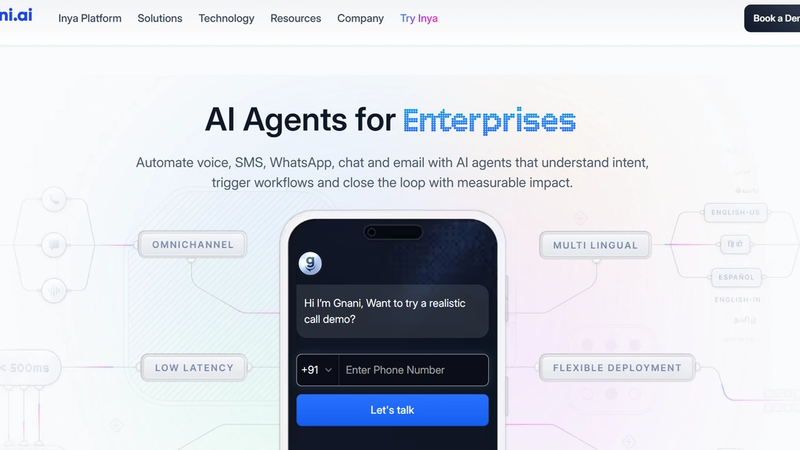
Gnani.ai positions its voice platform around agentic AI for BFSI. It is built to support both inbound self-service and outbound motions such as collections, reminders, lead qualification, verification, and customer support.
It’s a practical fit when you want to automate high-volume voice workflows across regions and languages, and still keep performance measurable in production.
Key features that matter for Enterprise Banks and NBFCs
- Voice agents for inbound + outbound workflows
- Multilingual support (40+ languages including Indian regional)
- Voice biometrics for secure authentication
- Post-call analytics and speech intelligence
- Integration with CRM and core systems
Pros & Cons
| PROS | CONS |
| High multilingual support for India | Some large enterprise complexity |
| Proven results in major Indian banks | |
| In-call authentication features | |
| Outbound follow-ups and collections support |
3. Skit.ai: Best for insurance servicing and collections automation
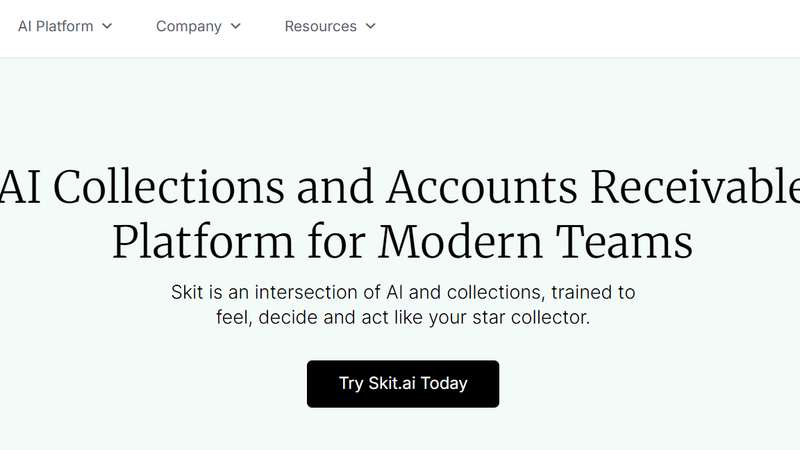
Skit.ai has dedicated BFSI and Insurance offerings focused on voice automation for servicing and recovery workflows. It is structured around common insurance journeys such as claim intimation, renewals, and policy servicing, and it is also used for BFSI collections where handling volume and language variation matters.
Key features that matter for Insurers
- Insurance-specific workflows (claim status, renewals)
- Multilingual voice understanding
- Sentiment and escalation logic
- Integration with contact centers environments
Pros & Cons
| PROS | CONS |
| Insurance workflow-centric automation | Requires operational deployment planning |
| Good regional language handling | |
| Useful for both inbound + outbound |
4. Yellow.ai: Best for enterprise banks & insurers with omnichannel automation
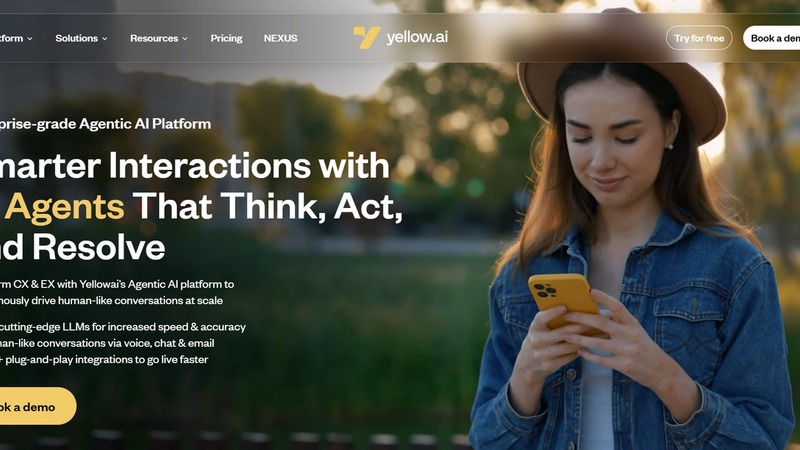
Yellow.ai is an enterprise conversational AI platform that includes voice bots as part of a broader omnichannel automation stack. It typically fits large BFSI customer operations where voice needs to work alongside chat and messaging channels, and where the platform is expected to plug into enterprise systems and governance workflows.
Key features that matter for Banks and Insurers
- Enterprise-grade automation with voice + chat + messaging
- 135+ language support including low-resource languages
- Real-time analytics and dashboards
- Role-based security and enterprise compliance features
Pros & Cons
| PROS | CONS |
| Strong integration options | Steep learning curve for advanced workflows |
| Ease of use | Some integration friction reported |
| Broad omnichannel capabilities |
5. Exotel GenAI Voicebot: Best for telephony-centric BFSI automation
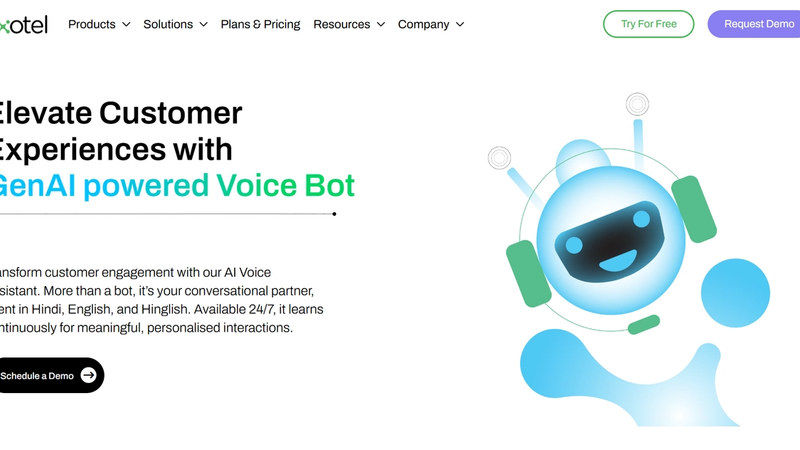
Exotel is a cloud telephony provider with an AI voice bot layer designed for BFSI scenarios such as EMI reminders, outbound follow-ups, and structured conversational call flows.
It is often considered when the telephony layer is central to the deployment and you want a voice automation layer that sits close to calling infrastructure, especially for collections-led workflows.
Key features that matter for BFSI
- Telephony-native voice AI
- Outbound dialing and scheduling
- RAG and sentiment analysis tools
- Integration with existing telephony stacks
Pros & Cons
| PROS | CONS |
| Strong telephony backbone | Voice analytics depth depends on integration |
| Practical BFSI workflows built in | |
| Useful for collections at scale |
6. Verloop: Best for insurers with deep automation and insights
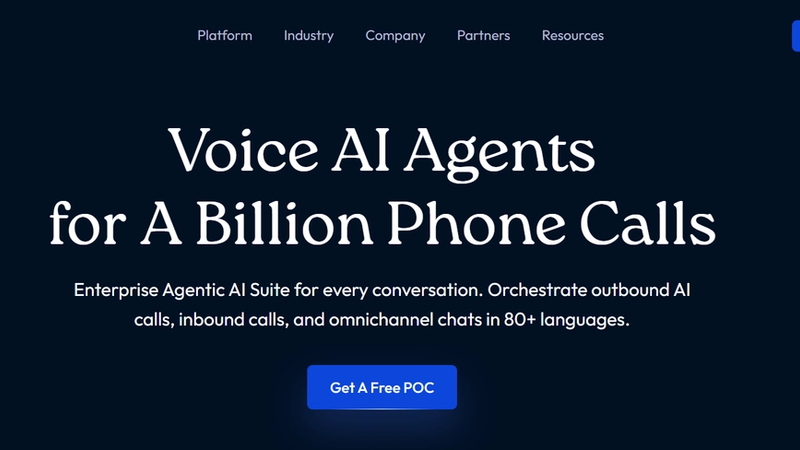
Verloop.io is a conversational automation platform used for voice and multi-channel engagement. It typically suits insurers that need a structured automation layer for servicing journeys and want visibility through analytics. If your priority is improving service efficiency while maintaining consistency and traceability across customer interactions, Verloop tends to map well.
Key features that matter for Insurers
- AI agent plus auto QA capabilities
- Analytics and reporting dashboards
- Omnichannel engagement including voice
- 100+ integrations for CRM and tools
Pros & Cons
| PROS | CONS |
| Strong automated QA | UI/dashboard usability issues |
| Deep integrations |
7. Gupshup: Best for banks seeking broad conversational engagement including voice
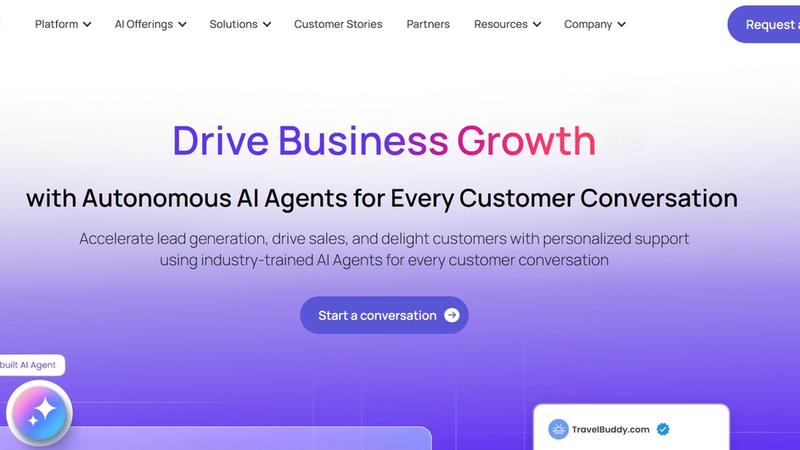
Gupshup is a conversational platform with a strong footprint across messaging channels (including WhatsApp, SMS) along with voice. It is typically a fit for banks that want a broad engagement layer across channels and prefer an API-first approach for building and orchestrating customer journeys, with voice as part of a larger conversational stack.
Key features that matter for Banks
- Conversational bots across channels (voice, chat, messaging)
- API-driven automation
- Integration-friendly ecosystem
- Ease of deployment
Pros & Cons
| PROS | CONS |
| Strong multi-channel engagement | Some dashboard responsiveness issues |
| Integrations and reliability | Administration UI issues |
Conclusion
Voice AI in BFSI is no longer just about answering calls or replacing an IVR. The real value comes from running voice workflows reliably at scale, while staying within compliance requirements and keeping customer experience consistent.
Each platform in this list has a different strength. Some are better for monitoring and QA, some for multilingual coverage, some for insurance servicing, and others for telephony-led execution or broader conversational automation.
When you shortlist, don’t judge only on the demo. Focus on what matters after go-live: audit-ready logs, language accuracy on real customer calls, safe escalation to agents, smooth integrations with your telephony and CRM, and the ability to spot and fix issues quickly. That is what makes voice AI usable in production for banks and insurers.
Frequently Asked Questions (FAQs)
1. Which BFSI use cases should we automate first with voice AI?
Start with high-volume, low-risk flows: lead qualification + instant callback, renewal/EMI reminders, claim status, and basic service requests. Prove containment and CX first, then expand into regulated workflows.
2. What does “observability” mean for voice AI and why does it matter in BFSI?
BFSI gets too many calls to QA manually. Observability shows what’s breaking across all calls (missed disclosures, routing issues, language failures) so you fix problems early, not after complaints spike. ReachAll is the ideal, one-stop solution for automating calls and monitoring them.
3. How do we prevent compliance drift in automated calls?
Use locked scripts for regulated flows, enforce mandatory disclosures, log consent, and keep audit-ready transcripts/recordings. Add QA checks that flag deviations and trigger human handoff for edge cases.
4. How do we evaluate language performance for India (accents, code-mixing, regional languages)?
Do a pilot with your real call recordings and a scorecard: recognition accuracy, barge-in handling, latency, and escalation rate by language/region. Don’t trust language claims without production-like testing.
5. What happens when the AI gets stuck or the customer is frustrated?
You need clear escalation rules: “agent” intent, repeated confusion, long silences, high emotion, or high-value customers. Warm transfer should pass summary + captured fields so the customer doesn’t repeat.
6. Can voice AI handle KYC-style verification and consent capture?
Yes, if the platform supports scripted verification, explicit consent prompts, and auditable logging. Treat it like a controlled workflow, not an open-ended conversation.
7. How should we think about outbound voice AI for collections and reminders?
Run it as a governed campaign: segmentation by delinquency stage, strict scripts, retry logic, and escalation thresholds. Measure connect rate, right-party contact, and downstream payment outcomes.